


I am back in Cameroon. This time I am on a completely different trajectory, because I am now officially retired from my professor position at San Francisco State University. I am now making it public, that I accepted a one-year salary incentive to retire early. I will have a nice pension for the rest of my life. So now at nearly 60 years old, I am taking a new path. I am now an Emeritus Professor. I will be continuing my research but ending the teaching. This gives me much greater flexibility to devote my time to projects like the one I am working on here.


I arrived after a long flight on Ethiopian airlines at Douala. Same airport, nothing has changed. The air is warm and humid and people sit on the hard plastic chairs. My baggage got lost going to Stockholm, and then again to Geneva, but not here! Then my wonderful colleagues picked me up, got me through the traffic of Douala, and brought me to Buea, to stay at the Mountain Hotel. I was here in 2018, under a strict lockdown because of the Ambazonian crisis that had erupted, and it was unsafe to leave for about a week. The separatists want independence of the English-speaking Northwest and Southwest Regions from the rest of Cameroon. At first, they had some momentum, but then they got violent and started kidnapping people. Nobody believes in Ambazonia independence anymore. Anyway, since the crisis, nothing has changed at this government hotel. It has just become a little more run down. I believe that I may have been the only person staying there, in the huge complex. From my pretty expensive room (for what it is), I could see the majestic huge Mt. Cameroon, which is over 4000 meters high. This part of Buea has always been safe, but the hotel where I used to stay downtown is in the risky territory of where I could be kidnapped. And the sites where we worked for several years are deep into the separatist strongholds. This means that we are going to explore and initiate work at new sites. Again, at a palm oil plantation to study how deforestation and monocultures are affecting bird diseases; and the mosquitoes that transmit malaria.
I gave a lecture at the University of Buea. The students were welcoming and eager to talk to me, although somewhat shy. A lot of them took photos with me, as if I were a scientific celebrity. I feel very appreciated here, and I also think I have influenced a lot of young people in their career choices. Now I realize how hard it is here to do science, so I also feel somewhat bad that I have promoted studying disease ecology, and now it is nearly impossible to get money, or academic positions doing this type of work. Science in the USA has become more difficult since the advent of Trump, but here it is exponentially worse. There is no guarantee of electricity at the university, so freezers are unreliable. This means that one can’t really do molecular biology, since so many reagents must remain frozen. There are no projectors for teaching with Powerpoints, and everything is in disrepair. PhD programs have been all but suspended. The roads are nearly unpassable, and wifi is nearly non-existent.
Unfortunately, I got sick, with a bad stomach flu. I think it was from eating raw tomatoes. I was sweating at night with a pretty high fever. And then we couldn’t depart Buea for a couple extra days because the car had broken down. Also, Mondays are always Ghost Town days, where no one can travel in the English-speaking parts of Cameroon. I don’t really understand how a few rebels can institute such a peculiar policy, but it is observed, and the city basically shuts down on Mondays.

Tuesday morning, we packed up the car with all our field and camping gear, and the team of 8 people headed out for the trip to Yaoundé, where we needed to get permits and meet some people. Nine and a half hours later, we arrived, ragged from the rugged road, and squished conditions in the car. We stay at the UCLA Center For Tropical Research: the institute I have been affiliated with for now over 25 years. It is very familiar, and again, not much has changed. It is in probably the safest part of Yaoundé, behind the Chinese embassy, and across the street from the headquarters for the Cameroonian special forces, who are trained by Israelis and Americans. We don’t even need to unpack the car, because it is that safe.
Then a couple days in Yaoundé. I visited the Monument of the Reunification of Cameroon, which is a spiral steeple in a little park surrounded by busy traffic in the center of the city. I feel a little sad for a country, if this is the main monument they can come up with. Graffiti inside, and, well it’s just not that great. I also finally visited the National Museum, which is a propaganda factory for Paul Biya, the 93-year-old president who has been in office since 1982. It has some dioramas of life in the different regions of Cameroon, but very little true art. More of it focuses on the historical bigwigs of the country. It costs $10 to get in, and if you want photos another $10 (so you will not find photos here). The guide must accompany at all times, but it is dilapidated, and in disrepair. Instead of feeling inspired, it inspires grief for a country so rich in potential and resources, but where corruption has its roots so deep, it limits any successes or motivation for maintenance.


I get around in shared taxis, where you just point your finger, and they stop. It’s a truly efficient way of getting around. Easier than Uber or Bolt. You say where you want to go, and how much you want to spend, and you get there, sometimes crowded in the back, or even 2 guys sitting on laps, sharing the front seat. It usually costs around 50 cents. I tell the drivers (the English- speaking ones, I still don’t speak French), about Waymos and robot cars in San Francisco. They are astonished by such science fiction. It will be eons before that technology comes to Cameroon.

After a couple meetings, we got the necessary permission to work at CAMVERT, a huge oil palm plantation in the South of Cameroon, carved from an incredibly rich rainforest, next to the border with Equatorial Guinea. The palm trees stretch for as far as you can see. We are guests of the administration and are welcomed with open arms. We stay at the guest house and immediately begin working. We set up many mist nets for the birds and traps for mosquitoes. We are well oiled in this work, and it moves seamlessly. We have been working together as a team for more than 10 years. This is the easy part, and we all have our assigned roles and know exactly what to do. We catch a lot of our bird friends in the forest and compare them to the birds we catch in the palm plantation. The forest edge is most interesting to us, and just past the edge, we hear monkeys, and the forest is incredibly, surprisingly rich and intact. The place is fascinating, and we now have permission to continue this work for several years. This time we are not camping, but simply staying at the guest house, which has electricity, but not running water. Several of my teammates don’t have electricity in their homes in Buea, so this is luxury living. We have a cook, who makes meals from the food we have bought, and we get water from the well. The cook always makes a veganized portion for me; spaghetti, or beans and rice. One day we had okra soup with gari. Everyone is happy.


I never know what will happen on my trips to Cameroon, but it is always an adventure, and usually things work out just fine. I get sick, and I recover. We fight to get permits, and they eventually come through. We have problems with the vehicles, and logistics, but it just takes time and patience. The people here are tough, they work hard, and they are resilient. There is music playing in the car and the guys sing when they know the words to the songs.


I swim every evening in the huge Campo River and watch the sunset while I bathe. Right across the river is Equatorial Guinea, I could literally swim there, but there is no good beach on the other side, just mangroves. We took an afternoon, and my teammates went to Equatorial Guinea to go shopping, since things are much cheaper there. I couldn’t go because I didn’t have a visa. I instead watched the boats going back and forth carrying fruits to EG and bringing back all kinds of drinks and liquor. This is probably the most beautiful place I have visited in Cameroon, with the rainforest and birds, and vast river. I find myself attracted to places where there are few people. The work is hard, and getting here is such a challenge, but wow, every day in this life of mine is an amazing adventure.
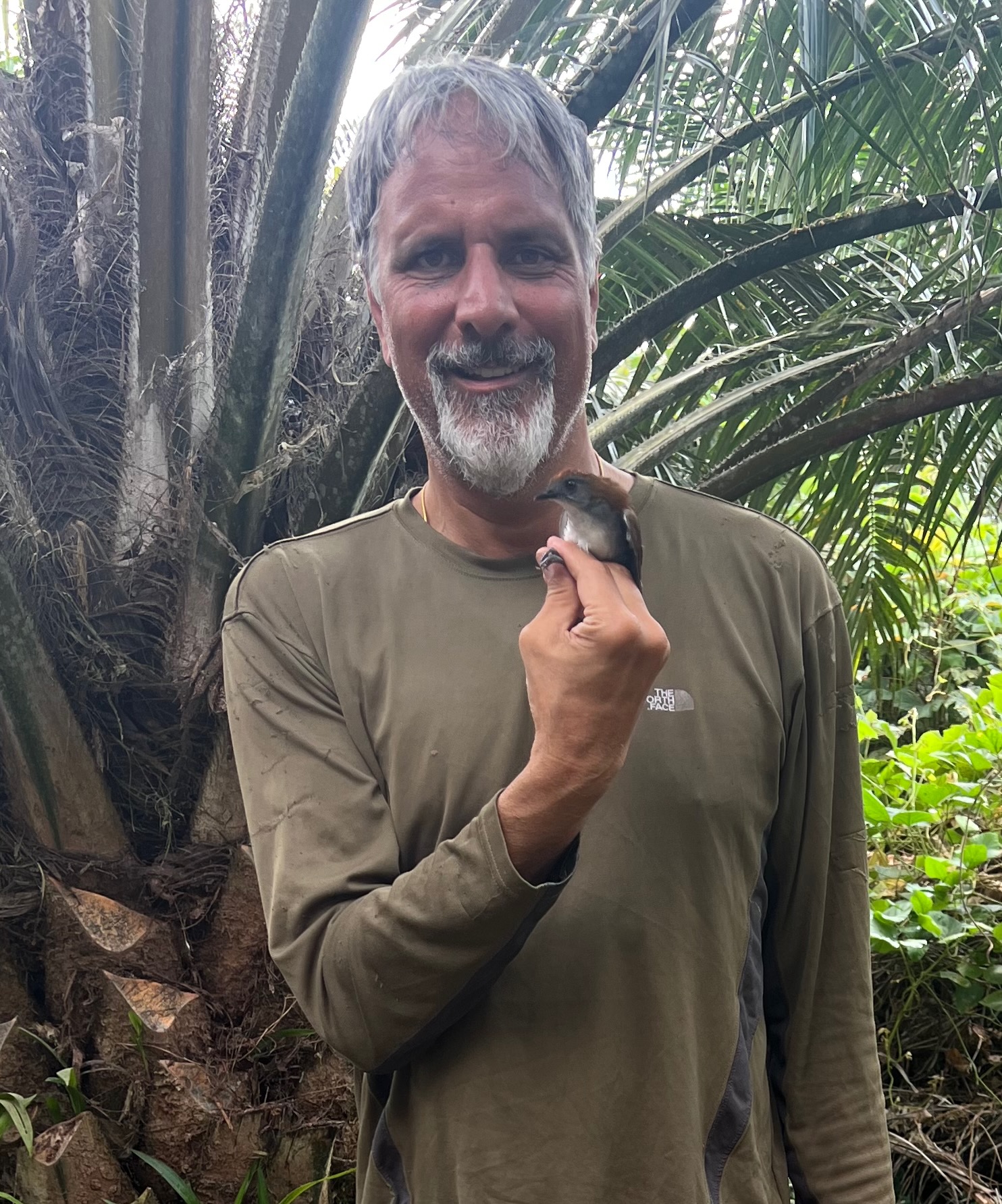
Why do I continue to do this work? First, I am fascinated by these landscapes and by what happens to rainforest ecology after the establishment of palm oil plantations. Over the years, I have developed a deep connection to these forests, making it heartbreaking to witness their destruction. Second, I love working with my teammates, the young scientists whose stamina, dedication, and enthusiasm continue to amaze me. They work tirelessly under difficult conditions without ever complaining, and they represent the future of science in this country. Finally, I do this for myself. When the trip is over, with the exhaustion and challenges, I look back and reflect, and I am pretty impressed that I can still do this.